
Priorities for a Head of Maths in Autumn 2
By Tariq Khan | TK Maths Academy
Autumn 2 is where the work you completed in the first half term should begin to translate into measurable improvements. Your routines are established, the curriculum is underway and initial assessments should give you a clearer picture of strengths and weaknesses across your department.
Your challenge now is knowing what to prioritise. It is easy to respond to every assessment result, learning walk or concern by introducing another initiative. Before long, you can have a department full of actions but little time to evaluate their impact.
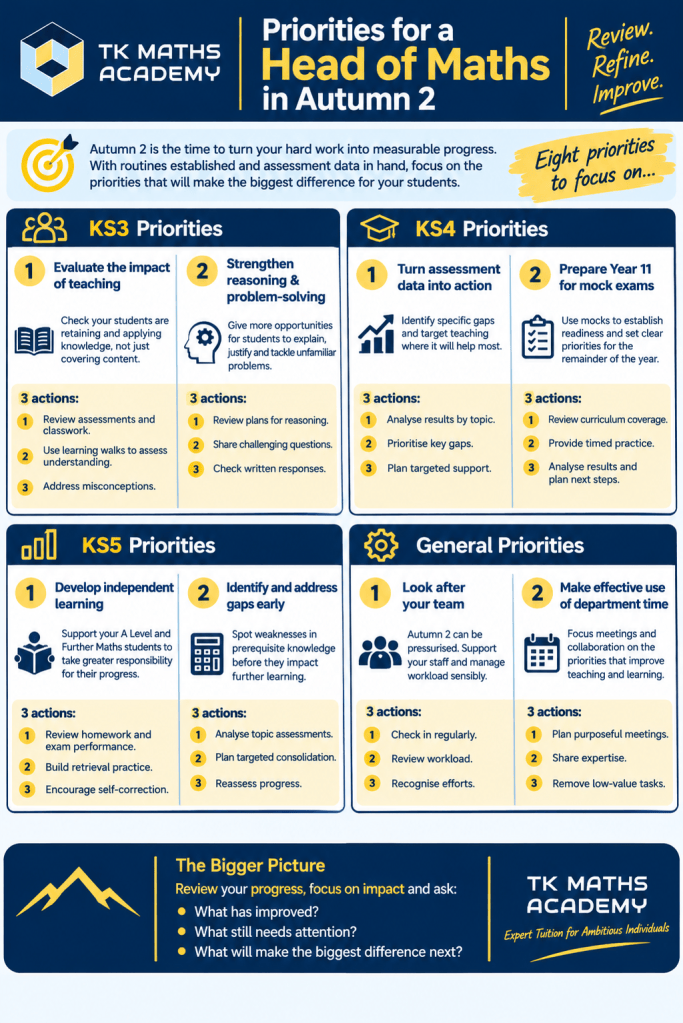
In my opinion, Autumn 2 should be about prioritising, responding and refining. Here are eight priorities I would recommend focusing on.
KS3 Priorities
KS3 can easily become overlooked as GCSE and A Level demands increase. However, this is an important opportunity to evaluate whether your students are developing secure mathematical knowledge.
1. Evaluate the impact of teaching on students’ understanding
You should now have enough evidence to evaluate whether your students are learning what you intend them to learn. Covering the curriculum is not enough; students need to retain knowledge, apply it and make connections between topics.
For example, can your students apply their understanding of fractions when working with ratio, percentages or algebra?
3 actions:
- Review assessments and classwork to evaluate students’ retention and application of knowledge.
- Use learning walks and book reviews to explore the quality of mathematical understanding.
- Identify common misconceptions and agree how teachers will address them through modelling, questioning and practice.
2. Strengthen mathematical reasoning and problem-solving
Your students need to develop more than procedural fluency. They should be able to explain their thinking, justify answers and apply familiar methods to unfamiliar problems.
These habits are essential in preparing students for the demands of GCSE Mathematics.
3 actions:
- Review your medium-term plans to identify opportunities for reasoning and problem-solving.
- Share effective questions that encourage students to explain, compare and justify mathematical approaches.
- Review students’ written explanations to identify areas requiring further development.
KS4 Priorities
Autumn 2 is a crucial point for KS4. Your Year 11 students are approaching mock examinations, while Year 10 students continue building the knowledge needed for GCSE.
Your focus should be on ensuring teaching, assessment and intervention target the areas that will make the greatest difference.
1. Turn assessment data into precise teaching priorities
Move beyond headline grades and identify exactly what your students can and cannot do. Two students working towards Grade 5 may have very different needs: one might struggle with algebra, while another loses marks through weak proportional reasoning or interpreting questions.
Your challenge is to identify these gaps and adapt your teaching accordingly.
3 actions:
- Analyse recent assessments by question, topic and class to identify patterns in performance.
- Prioritise misconceptions and knowledge gaps that prevent students from accessing future content.
- Address these through classroom teaching, retrieval practice and targeted intervention, followed by reassessment.
2. Prepare your Year 11 students for mock examinations
Your mock examinations should establish what students know, what they can apply independently and what they need to improve before their final GCSEs.
Avoid trying to revisit the entire specification or focusing solely on predicted grades. Instead, use mocks to establish clear priorities for the remainder of the year.
3 actions:
- Review curriculum coverage and identify essential content that needs teaching or consolidation before mocks.
- Provide opportunities for students to complete timed exam questions and full papers.
- Establish a process for analysing results and identifying lost marks to inform post-mock intervention and teaching.
KS5 Priorities
At KS5, you need to maintain the pace and depth required by post-16 mathematics while ensuring students develop the independence needed to succeed.
1. Develop independent learning and exam readiness
A Level Mathematics and Further Mathematics require students to take greater responsibility for their learning. Understanding a method in your lesson is not the same as applying it independently several weeks later.
Year 12 students need to adjust to the increased pace and challenge, while Year 13 students should increasingly focus on applying knowledge across topics.
3 actions:
- Review homework, independent practice and assessment performance to identify students struggling with the demands of their course.
- Build cumulative retrieval and mixed-topic practice into teaching and independent study.
- Encourage students to review errors, revisit weak topics and take greater ownership of their preparation.
2. Identify and address gaps before they compound
Weak prerequisite knowledge can significantly affect students’ ability to access later A Level content. For example, weaknesses in algebraic manipulation can create difficulties across functions, differentiation, integration and logarithms.
Identify these gaps early, before they become more difficult to address.
3 actions:
- Analyse assessments and students’ working to distinguish conceptual misunderstandings from weaknesses in prerequisite knowledge.
- Plan targeted consolidation activities without unnecessarily slowing curriculum progression.
- Reassess students to establish whether their accuracy and independence have improved.
General Priorities
Alongside your work across each key stage, you need to ensure your department operates effectively and that your leadership supports both staff and students.
1. Look after your team
Autumn 2 can be one of the toughest half terms. It is a long stretch between October half-term and Christmas, often bringing seasonal illnesses, increased staff absence, assessment deadlines and significant marking workloads.
It is easy to become so focused on curriculum coverage and assessment outcomes that you overlook how your team is coping.
Your teachers are juggling marking, mock preparation, intervention, reports and the usual demands of classroom teaching. This is a time when your leadership really matters. Recognise when your team is under pressure and be realistic about what genuinely needs to be done.
Looking after your team does not mean lowering expectations. It means creating the conditions for teachers to do their jobs effectively without unnecessary pressure.
3 actions:
- Check in regularly with your teachers about their workload, wellbeing and any additional pressures.
- Review marking, assessment and administrative expectations to identify tasks that can be reduced, streamlined or postponed.
- Recognise and appreciate your team’s efforts, particularly when colleagues are covering additional responsibilities during periods of staff absence.
2. Make effective use of department time and staff expertise
Your teachers are one of your department’s greatest resources. Use their knowledge and experience to improve teaching and learning rather than allowing department meetings to become entirely focused on administration and operational issues.
3 actions:
- Plan department meetings around the most important teaching and learning priorities.
- Use collaborative planning, moderation and resource sharing to address specific areas of need.
- Review staff workload and remove unnecessary tasks so teachers can focus on planning, teaching and supporting students.
The Bigger Picture
Autumn 1 is about establishing the foundations. Autumn 2 should be about checking whether those foundations are strong enough to support the progress you expect.
The most effective Heads of Maths are not necessarily those who introduce the greatest number of initiatives. They are the ones who identify the biggest barriers to learning, bring their teams together and evaluate whether their actions are making a difference.
As you approach the end of the autumn term, ask yourself three questions:
- What has improved? Identify the changes in teaching, learning and student outcomes that you can evidence.
- What still needs attention? Be honest about the gaps that remain and the students who need further support.
- What will make the biggest difference next? Agree a small number of priorities to take into the spring term.
The aim is not to do more for the sake of doing more. It is to make sure that the work you are already doing is having the impact your students deserve.


Leave a Reply