
By Tariq Khan | www.tkmathsacademy.co.uk
The start of a new academic year is one of the most important times for a Maths Department. Autumn 1 sets the tone for the year: expectations are established, curriculum gaps become visible, new staff settle in, and leaders begin to build the evidence that will inform the rest of the year.
For a Head of Maths, the challenge is to avoid trying to improve everything at once, trust me when I say not only will you burn out by the end of September, but your brain will also be all over the place and less effective. In my opinion, Heads of Maths should identify a small number of priorities, establish clear actions and monitor their impact consistently.
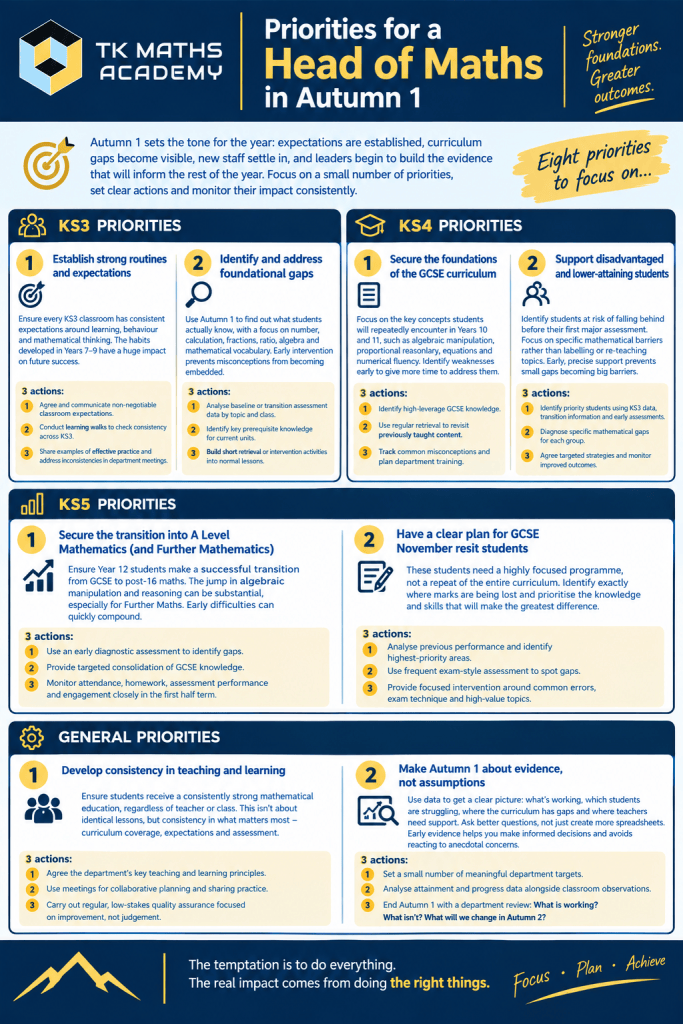
Here are eight priorities for Autumn 1, in my opinion, to focus on.
KS3 Priorities
Yes, I’m starting with KS3 as this is often the last priority for many HODs, when it should be equal, especially in Autumn 1 where there’s less “distraction” with exam classes/students. A great place to start is the KS3 Mathematics guidance published by DfE (written by NCETM), which I highly recommend you read.
1. Establish strong routines and expectations
The first priority should be to ensure that every KS3 classroom has consistent expectations around learning, behaviour and mathematical thinking.
Students should know what a successful Maths lesson looks like, how they are expected to present their work, how they should respond when they make mistakes and what they should do when they are stuck.
The habits developed in Years 7–9 have a significant impact on students’ future success. If students become accustomed to giving up when work becomes difficult, avoiding explanation or relying on procedures without understanding, these habits become increasingly difficult to change later.
3 actions:
- Agree and communicate a small number of non-negotiable Maths classroom expectations.
- Conduct learning walks to check consistency across KS3.
- Use department meetings to share examples of effective practice and address inconsistencies.
2. Identify and address foundational gaps
Autumn 1 is an ideal opportunity to establish what students actually know rather than relying solely on their previous year’s grades.
Attention should be given to number, calculation, fractions, ratio, algebra and mathematical vocabulary—the foundations upon which much of the secondary curriculum is built.
A student who cannot confidently manipulate fractions will struggle with algebraic fractions, probability and ratio. A student with weak number sense may struggle across almost every mathematical topic.
Identifying these gaps early allows intervention to happen before misconceptions become embedded.
3 actions:
- Analyse baseline or transition assessment data by topic and class.
- Identify the most important prerequisite knowledge for current units.
- Build short retrieval or intervention activities into normal lessons rather than relying solely on separate intervention programmes.
KS4 Priorities
1. Secure the foundations of the GCSE curriculum
Autumn 1 should not simply be about racing through the GCSE specification. The priority should be establishing secure understanding of the key concepts that students will repeatedly encounter throughout Years 10 and 11.
This includes areas such as algebraic manipulation, proportional reasoning, equations and numerical fluency.
GCSE Maths is highly interconnected. Weaknesses in fundamental areas often affect performance across many apparently unrelated questions.
A department that identifies these weaknesses early has considerably more time to address them than one that discovers them during Year 11 revision.
3 actions:
- Identify the high-leverage GCSE knowledge that students need to secure.
- Use regular retrieval to revisit previously taught content.
- Track common misconceptions across classes and plan department training to address these.
2. Establish a clear strategy for disadvantaged and lower-attaining students
Autumn 1 is the time to identify students who are at risk of falling behind—not wait until their first major assessment.
The focus should be on specific mathematical barriers, rather than simply labelling students as “low ability” or re-teaching a certain topic again.
Students who struggle with Maths often experience repeated failure, which can affect confidence and engagement. Early, precise support can prevent small gaps becoming significant barriers to achieving a GCSE qualification.
3 actions:
- Identify priority students using KS3 data, transition information and early assessments.
- Diagnose the specific mathematical gaps for each group of students.
- Agree targeted classroom strategies and monitor whether they are improving outcomes.
KS5 Priorities
1. Secure the transition into A Level Mathematics (and Further Mathematics)
For Year 12, the priority should be ensuring that students make a successful transition from GCSE to post-16 mathematics.
The jump in algebraic manipulation and mathematical reasoning can be substantial.
For Further Mathematics students, this transition can be even more demanding, think carefully about the course structure for these students.
Early difficulties can quickly compound. A student who has not secured GCSE algebra may struggle with logarithms, calculus, proof and more advanced algebra later in the course.
The first few weeks therefore provide an important opportunity to identify students who need additional support.
3 actions:
- Use an early diagnostic assessment to identify transition gaps.
- Provide targeted consolidation of GCSE knowledge where required.
- Monitor attendance, homework, assessment performance and engagement closely during the first half term.
2. Have a clear plan for GCSE November resit students
For students resitting GCSE Maths in November, Autumn 1 is effectively their final preparation period.
These students need a highly focused programme, rather than simply repeating the entire GCSE curriculum.
Students entering a November resit often have a history of difficulty with Maths. Repeating the same teaching approaches that did not work previously is unlikely to produce a different outcome.
The department needs to identify exactly where marks are being lost and prioritise the knowledge and skills that can make the greatest difference.
3 actions:
- Analyse students’ previous GCSE performance and identify their highest-priority areas for improvement.
- Use frequent exam-style assessment to identify remaining gaps.
- Provide focused intervention around common errors, exam technique and high-value topics.
General Priorities
1. Develop consistency in teaching and learning
One of the most important jobs of a Head of Maths is to ensure that students receive a consistently strong mathematical education regardless of which teacher or class they are in.
This does not mean every teacher delivering identical lessons. It means establishing consistency around the things that matter most.
Students should not experience dramatically different expectations, curriculum coverage or approaches to assessment simply because they are in a different classroom.
Consistency also makes it easier for the department to identify what is working and where improvement is required.
3 actions:
- Agree the department’s key teaching and learning principles.
- Use departmental meetings for collaborative planning and sharing effective practice.
- Carry out regular, low-stakes quality assurance focused on improving teaching rather than simply judging it.
2. Make Autumn 1 about evidence, not assumptions
A strong Head of Maths should leave Autumn 1 with a much clearer understanding of the department: what is working, which students are struggling, where the curriculum has gaps and where teachers need support.
Data should be used to ask better questions—not simply to create more spreadsheets.
Early evidence allows you to make informed decisions before problems become difficult to reverse. It also prevents leaders from responding to anecdotal concerns that may not actually represent the wider picture.
3 actions:
- Establish a small number of meaningful department targets for the year.
- Analyse assessment, attainment and progress data alongside what leaders see in classrooms.
- End Autumn 1 with a department review: What is working? What isn’t? What will we change in Autumn 2?
The Bigger Picture
The temptation in September is to create a huge improvement plan containing dozens of actions, in my opinion you should do the opposite.
Autumn 1 should be about getting the foundations right.
If these priorities are established well in the first half term, you will be in a much stronger position to move into Autumn 2 with a clear understanding of where the department needs to go next.
The aim isn’t to do everything in Autumn 1. The aim is to identify what matters most—and do those things exceptionally well.
 tkmathsacademy.co.uk
Leave a comment